


AI in Health Care: From Strategies to Implementation
Harvard Medical School AI in Health Care Program: Drive Responsible AI Adoption
The Harvard Medical School Executive Education AI in Health Care program is an eight-week online program that equips health care leaders to design, pitch, and implement AI-driven solutions that improve patient outcomes, integrate AI technologies, and drive transformative change in health care systems.
The program focuses on real-world applicability, using case studies and actionable frameworks to tackle data quality, bias, trust, regulatory demands, and skills gaps, equipping leaders to advance patient-centric innovation.
Note: This non-degree program offers a certificate of completion to participants who meet the program requirements. It does not grant academic credit or provide certification for specific professions.
What Will You Learn in the Harvard Medical School AI in Health Care Program?
Key Program Takeaways
Core concepts: Understand the fundamentals of modern AI, including the role data and computing play in building successful applications, to improve overall patient experiences and outcomes.
Critical evaluation: Evaluate existing AI systems in health care to quantify their strengths and weaknesses.
Innovation opportunities: Identify new opportunities to address modern health care needs with AI.
Ethical implementation: Assess the potential biases and ethical implications of AI technologies in health care settings to ensure that any AI solution promotes data privacy, data integrity, and trust.
How Is the AI in Health Care Program Curriculum Structured?
The AI in Health Care program curriculum is structured to help participants translate AI concepts into actionable AI solutions that enhance patient care and support innovation in health care systems. Through this eight-week online program, you develop a deep understanding of real-world data, digital medicine, and AI applications. The learning experience encompasses recorded and live sessions with faculty and guests, interactive discussions, weekly live office hours, scenario-based assignments, case studies, real-world examples, and a capstone project.
1
Module 1: The History and Foundations of AI
AI has come a long way in a short amount of time. Examine its evolution, differentiate between supervised and self-supervised learning and explore emerging AI applications in health care.
2
Module 2: A Framework for the AI Development Pipeline
Creating and implementing an AI health care solution involves a careful balance of training, validation and deployment. Explore each stage of the AI development pipeline and formulate an idea for an AI-driven health care solution that you will work on throughout the program to fulfill the capstone requirement.
3
Module 3: From the Lab to the Real World
Leveraging the power of AI in a health care setting can be challenging. Examine the complexities of developing successful AI-driven products for the health care industry and identify the factors that must be considered to create a successful product.
4
Module 4: Transparency, Reproducibility and Generalizability in AI
Risk prediction models assess the likelihood of a given outcome. Discover common evaluation measures used with these models and the level of certainty required for clinical decision making.
5
Module 5: The Potential for Bias and Harm in AI
The AI development pipeline offers a host of benefits, but it also introduces potential ethical concerns. Examine each pipeline stage through the lens of ethics and equip yourself with the knowledge to identify and avoid ethically problematic choices and practices throughout the development process.
6
Module 6: AI for Startups
AI implementation carries a unique set of considerations for startups. Guided by a leader in the AI startup world, learn to transform your idea for an AI-first health care solution into a compelling story and viable investor pitch.
7
Module 7: AI for Wearable Data
Person-generated health data (PGHD) gathered by wearable devices and machine learning algorithms offer a wide range of new health care possibilities. Explore the advantages and disadvantages of leveraging machine learning to collect and assess wearable data and examine the role of community benchmarks and transparency in developing machine learning methods.
8
Module 8: Live Session — Capstone Presentations
A viable pitch is instrumental to securing funding for an AI-first health care solution. Join the members of your cohort as some of them share pitches for their solutions and examine what makes an effective pitch and why.
Learning Experience

Capstone project

Certificate of completion from Harvard Medical School Executive Education

Crowdsourcing

Guest speakers

Immersive discussions

Polls and knowledge checks

Weekly live office hours with the course facilitator

Live session with lead faculty

Real-world examples and case studies

Practical, scenario-based assignments
Live Sessions
Focused session on Agentic AI in Health Care
Led by Arjun (Raj) Manrai, explore the emerging role of agentic AI in health care and its implications for health care organizations, including the evolution of AI toward autonomous agents, relevant health care applications, and the strategic, operational, and governance considerations that health care leaders should prepare for as these technologies mature.
Capstone Presentation
Experience a dynamic exchange of ideas as finalists present their innovation AI-first health care solutions. This optional session offers an opportunity to explore diverse approaches, spark new thinking, and celebrate creativity in advancing health care through AI, with a final vote from attending participants to determine the strongest capstone.
How Does the AI in Health Care Program Prepare You to Drive Real-World AI Impact?
Case Studies

EchoNet-Dynamic
Leveraging the AI development pipeline to optimize health care solutions

Evidation
Employing machine learning to collect real-time health data

Flagship Pioneering
Approaching new opportunities for AI in health care
Generate: Biomedicines
Using generative AI for innovation in health care
Google Health
Applying the principles of human-centered design to health care solutions

Sage Bionetworks
Leveraging AI to offset bias in health care
Capstone Project
The Harvard Medical School AI in Health Care program incorporates a capstone project requiring you to ideate and pitch a new AI-first health care solution that addresses a modern-day need. The project prepares you to design and implement innovative, real-world solutions that elevate the level of care your organization offers to today’s health care consumers. The project spans the course of the program, enabling you to incorporate the concepts and frameworks you learn in each module to develop your pitch.
Scenario-Based Assignments
Algorithmic Trust: Leveraging predictive models for decision making
Model Cards: Building transparency and trust in an AI model
Machine Learning for Wearables: Designing solutions that combine machine learning and wearable data
AI Viability in Health Care: Training and developing an AI model
Who Is the Harvard Medical School AI in Health Care Program For?
Role | Program benefits |
Medical professionals and researchers | Gain practical knowledge of how to integrate AI technologies to transform health care processes and improve decision making in patient care. |
Health care leaders and executives | Implement AI initiatives that improve patient care, enhance operational efficiency, foster innovation, and give organizations an edge in today’s complex health care landscape. |
AI technology and innovation enthusiasts | Understand AI’s potential to transform health care and lead innovation to create cutting-edge solutions that meet the needs of today’s health care systems and patients. |
Health care consultants, regulators, and policymakers | Guide organizations in adopting AI-driven solutions or developing policies for the use of AI in health care. |
What Past Participants Have to Say about the Program
"The most insightful aspect was gaining practical knowledge on integrating AI-driven technologies into clinical workflows and decision-making processes."
Hugo Lama
Eye Surgeon,
The Institut Daviel Ophtalmologie in Paris, France
"The best aspects of the program for me are the clarity of the presentations, the quality of the slides and the simplicity of the explanations, all of which made the course easy to understand and provided an excellent guide for future AI applications."...
Laura Rienzi
Scientific Director,
IVI-RMA
The capstone project, along with the instructions, and the way the curriculum was designed really stood out. The content was well interrelated and thought out. My instructor/facilitator was excellent and incredibly responsive, which is unique in online learning....
Adam Hahs
Chief Science Officer,
Hopebridge Autism Therapy Services
"The program was very comprehensive and covered the bases in a well-defined, logical learning path. I enjoyed gaining the latest AI insights, ensuring I am thinking about my current and future AI-driven projects in a different light."...
Dennis Watson
Vice President, Business Development,
Travera Inc
"For a newcomer to the technical world of AI, learning so many concepts and gaining ample food for thought has been very valuable."
Francisco Martinez-Saborido
Medical Director,
INTEGRAHEALTHCARE
"The best part of the program is understanding biases and other AI hallucinations. It’s crucial to recognize that AI is just a tool and must always be supervised and corrected by humans, particularly by doctors. The historical context is also very important."...
Jean-Luc Demaret
CHU Amiens
"The best part of the program was its clear and structured approach to AI implementation in health care, making complex concepts easy to understand. The real-world case studies and interactive elements provided valuable insights into applying AI to clinical practice, even in an online learning environment."...
Shaik Salam
Physician,
Ministry of Health
"The program is informative and flexible, allowing busy clinicians or entrepreneurs to participate in the learning. The amount of work required is also reasonable."
Linus Chuang
Chairman,
Nuvance health
"The program pushed me to learn progressively about AI and health care. I obviously had the drive to do it as I registered, but the program gave me structure, knowledge and deadlines. This was helpful to get outside of my comfort zone and start learning."...
Boris Gojanovic
MD,
Nuvance health
"The flexibility of the program schedule was great, so that I could watch lectures later if I needed to. Additionally, being able to hear everyone else's views and learn about their projects was also a critical and irreplaceable part of this program."...
Emily Molina
Rheumatologist,
Nuvance health
"The best part of the program is meeting highly intellectual and passionate faculty, who guide and mentor us on this journey of artificial intelligence, and interacting with diverse peers."
Olayinka Akinyemiju
Medical Advisor,
Greenhouse Capital
"I appreciate the broad approach of the program, which aimed to give a good overview, knowing everyone in the course had different levels of exposure (I had very little AI background). I also appreciate the ability to review the program at my own pace over the upcoming year. Due to varying clinical responsibilities, I was able to spend more time on certain modules than others, and I’m sure I will get a bit more out of it the second time around."...
Janice Hartnett
MD,
Hartford Health Care
Past Participant Profile
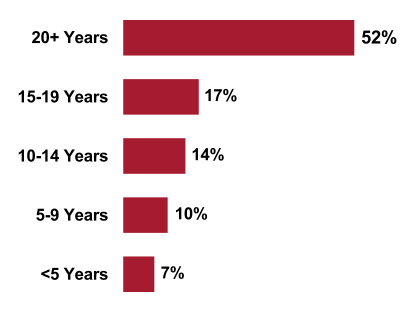
Work Experience
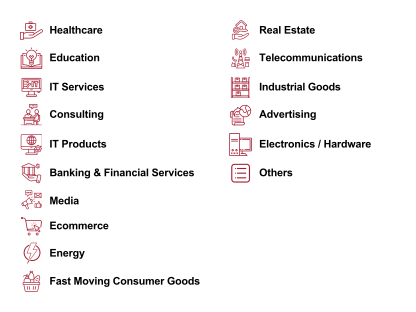
Top industries
Top countries

Meet the Faculty for the AI in Health Care Program

Andrew Beam, PhD
Chief Technology Officer, Lila Sciences; Associate Professor, Department of Epidemiology, Harvard T.H. Chan School of Public Health
Andrew Beam, PhD, is an expert in machine learning for biology and medicine and currently serves as the CTO at Lila Sciences, Inc., an organization that is developing new AI m...

Arjun (Raj) Manrai, PhD
Associate Professor of Biomedical Informatics, Harvard Medical School Senior Deputy Editor, NEJM AI
Arjun (Raj) Manrai, PhD is an Associate Professor in the Department of Biomedical Informatics at Harvard Medical School, where he leads a research lab that works broadly on ap...
Featured Guest Speakers for the AI in Health Care Program

Lily Peng, MD, PhD
Physician-Scientist; Deputy Editor, NEJM AI
Lily Peng, MD, PhD, is a physician-scientist and the deputy editor of NEJM AI. She is a former product manager, with a focus on data-driven health care solutions and applicati...

Sunny Virmani
Product Manager, Google Health
Sunny Virmani is a product manager with Google Health. He focuses on product development and global marketing of diverse medical imaging technologies. He holds a BS in instrum...

Karandeep Singh, MD, MMSc
Chief health AI officer at UC San Diego Health
Karandeep Singh, MD, MMSc, is the chief health AI officer at UC San Diego Health and the Joan and Irwin Jacobs Endowed Chair in Digital Health Innovation. He teaches a health ...

Marzyeh Ghassemi, PhD
Assistant professor at MIT in electrical engineering and computer science (EECS)
Marzyeh Ghassemi, PhD, is an assistant professor at MIT in electrical engineering and computer science (EECS) and Institute for Medical Engineering and Science (IMES) and a Ve...

Molly Gibson, PhD
Principal at Flagship Pioneering and works as part of a venture-creation team
Molly Gibson, PhD, is a principal at Flagship Pioneering and works as part of a venture-creation team to find and grow organizations at the intersection of biology and machine...

Luca Foschini
President and CEO of Sage Bionetworks.
Over the past decade, Foschini’s research has focused on the emerging field of digital medicine, with an emphasis on data recollection and analysis methodology. He co-founded ...
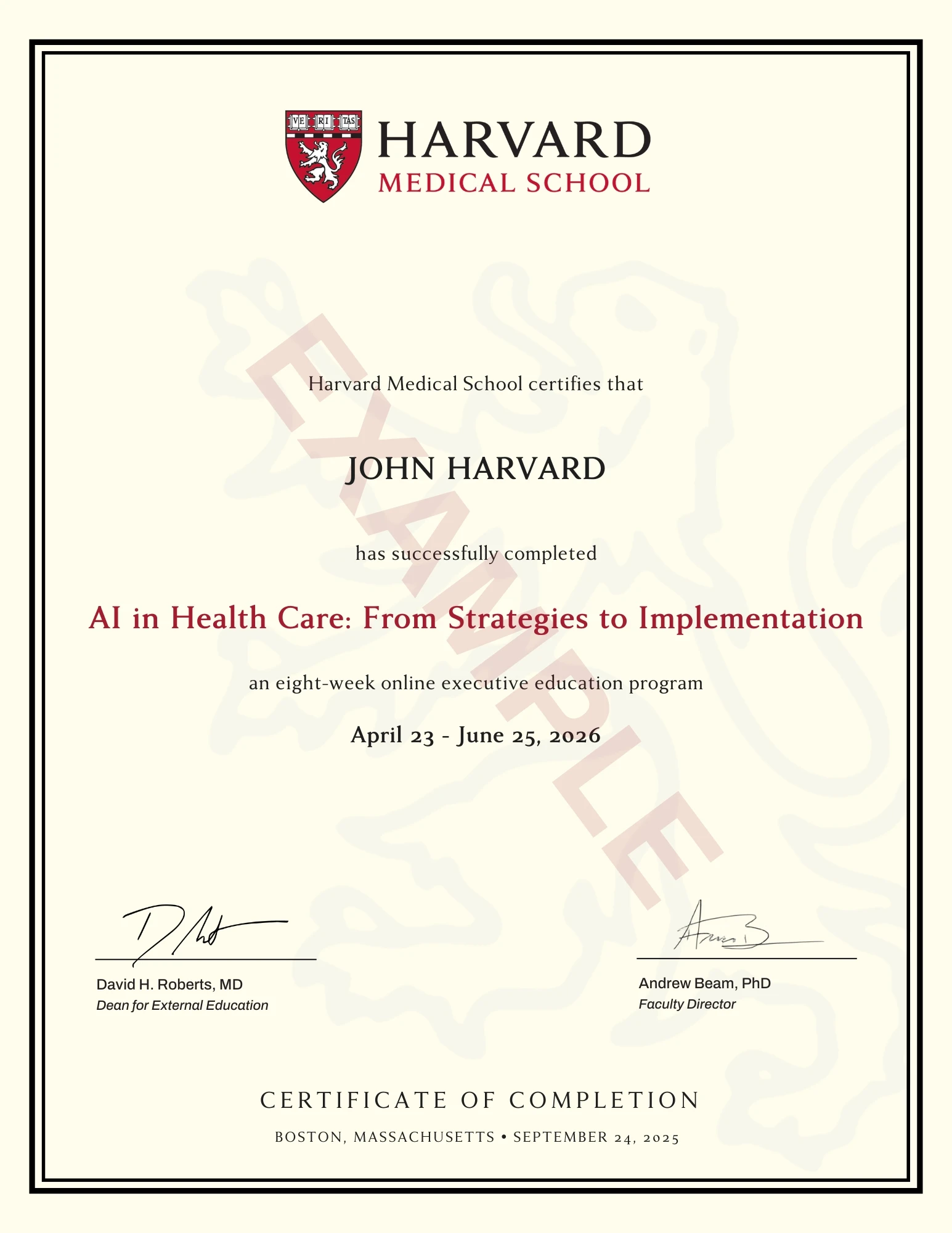
What Credentials and Outcomes Will You Gain from the AI in Health Care Program?
Upon completion of this program, you will receive a digital certificate from Harvard Medical School.
Note: The certificate details (name and dates) are placeholders. The final certificate will reflect the actual participant name, cohort dates, and date of issue.
Your digitally verified certificates will be issued in your legal name and emailed to you, at no additional cost, upon completion of the program, per the stipulated requirements. All certificate images are for illustrative purposes only and may be subject to change at the discretion of Harvard Medical School.
Note: This program does not grant academic or professional certifications from Harvard Medical School.
Receive an advanced certificate with this learning journey
Health Care Transformation program
Build Strategic Fluency in AI and Digital Transformation in Health Care
Engage in a comprehensive learning journey from Harvard Medical School Executive Education that combines two expert-led programs to enable digital health innovation and transformation. Gain the skills to implement artificial intelligence (AI) at scale, navigate governance, and lead initiatives that align technology adoption with enterprise strategy and sustainable health care impact.

Frequently Asked Questions
1
The Program
What makes the AI in Health Care program worth the investment?
The AI in Health Care course offers a unique combination of:
Expert instruction
Practical skills
Real-world case studies
Participants learn how artificial intelligence in health care can transform patient care, improve patient outcomes, and enhance operational efficiency. By analyzing health care data with advanced AI tools and machine learning techniques, participants develop strategies to implement AI-driven solutions that address current challenges in the health care sector. The capstone project ensures direct application of these strategies to organizational needs.
Which training program is best for health care and AI leadership?
There is no single best AI and health care program for everyone. The right program depends on your:
Goals
Experience
Resources
Career context
The AI in Health Care program blends foundational concepts in AI with applications across patient care, health care data, and emerging technologies. Participants explore machine learning algorithms, bias detection, and ethical implications of AI models while working through case studies that mirror current and future applications. The program prepares participants to lead health care AI initiatives that enhance clinical decision making and health care delivery.
How should I choose the right program for AI in health care leadership?
When selecting an artificial intelligence course in health care, consider the program's:
Curriculum
Faculty expertise
Opportunities for practical application
The AI in Health Care program combines health care artificial intelligence theory with real-world case studies and applied projects. Participants develop AI strategies that integrate machine learning, natural language processing, and data analytics to solve real-world health care challenges. The capstone project further ensures participants can implement AI in health care settings to advance patient outcomes and organizational efficiency.
How do I become a leader in AI in health care?
Becoming a leader in health care artificial intelligence involves developing both:
Technical expertise
Strategic vision
Participants in the AI in Health Care program gain practical experience in evaluating AI models, analyzing health care data, and applying AI-driven solutions to real-world health care challenges. Through case studies, faculty insights, and a capstone project, participants explore how AI technologies, from machine learning algorithms to decision support systems, can transform patient care and improve health system performance.
What education do you need to join the AI in Health Care program?
The AI in Health Care course is designed for professionals with backgrounds in:
Health care
Medicine
Research
Computer science
Related fields
While no specific degree is required, participants should have a foundational understanding of health care systems and an interest in emerging technologies such as machine learning and data science.
Who is the AI in Health Care program designed for?
The AI in Health Care program is ideal for:
Medical professionals
Health care leaders
Innovation-focused executives
Consultants
Policymakers
Researchers
The program is designed for professionals looking to implement AI-based health care solutions that elevate care delivery and operational efficiency. It also supports consultants, policymakers, and researchers guiding AI adoption across health care systems. Designed for those at the intersection of health care and technology, the program equips participants to lead transformative, AI-driven change for improved patient care.
Note: This program does not include training in AI for doctors intended for direct clinical decision making or patient treatment.
What type of certificate will I receive after completing the AI in Health Care program?
Participants who successfully meet the program requirements will receive a verified digital certificate of completion from Harvard Medical School. This is a non-degree program and does not grant academic credit or provide certification for any specific profession.
2
The Learning Experience
Will I learn how to lead an AI health care project or initiative?
The Harvard Medical School Executive Education AI in Health Care course includes:
A capstone project
Hands-on assignments
Case studies
The capstone project allows you to apply insights from each module to ideate and pitch a new AI-first health care solution that addresses a real organizational or patient care need. Combined with hands-on assignments and case studies, it prepares you to lead AI initiatives from concept to implementation.
Do I need a technical or coding background to enroll?
You do not need a coding background to enroll in the AI in Health Care program. It is designed for:
Medical professionals
Health care leaders
Professionals without a technical background
You learn how AI and health care intersect and how to evaluate and apply AI-driven solutions.
3
Certificate
What are the requirements to earn the certificate?
Each program includes an estimated learner effort per week, so you can gauge what will be required before you enroll. This is referenced at the top of the program landing page under the Duration section, as well as in the program brochure, which you can obtain by submitting the short form at the top of this web page. All programs are designed to fit into your working life.
This program is scored as a pass or no-pass; participants must complete the required activities to pass and obtain the certificate of completion. Some programs include a final project submission or other assignments to obtain passing status. This information will be noted in the program brochure. Please email us if you need further clarification on any specific program requirements.
What type of certificate will I receive?
Upon successful completion of the program, you will receive a smart digital certificate. The smart digital certificate can be shared with friends, family, schools, or potential employers. You can use it on your cover letter, resume, and/or display it on your LinkedIn profile.
The digital certificate will be sent approximately two weeks after the program, once grading is complete.
Will I earn a professional certificate, CEUs, PEUs, academic credits when I complete the program?
This program does not grant academic credits, CEUs, PEUs or professional certificate from Harvard Medical School. This non-degree program offers a certificate of completion to participants who meet the program requirements. It does not grant academic credit or provide certification for specific professions.
Can I get the hard copy of the certificate?
No, only verified digital certificates will be issued upon successful completion. This allows you to share your credentials on social platforms such as LinkedIn, Facebook, and Twitter.
Do I receive alumni status after completing this program?
No, there is no alumni status granted for this program. In some cases, there are credits that count toward a higher level of certificate. This information will be clearly noted in the program brochure.
How long will I have access to the learning materials?
You will have access to the online learning platform and all the videos and program materials for 24 months following the program start date. Access to the learning platform is restricted to registered participants per the terms of agreement.
4
Technical Requirements
What equipment or technical requirements are there for this program?
Participants will need the latest version of their preferred browser to access the learning platform. In addition, Microsoft Office and a PDF viewer are required to access documents, spreadsheets, presentations, PDF files, and transcripts.
Do I need to be online to access the program content?
Yes, the learning platform is accessed via the internet, and video content is not available for download. However, you can download files of video transcripts, assignment templates, readings, etc. For maximum flexibility, you can access program content from a desktop, laptop, tablet, or mobile device.
Video lectures must be streamed via the internet, and any livestream webinars and office hours will require an internet connection. However, these sessions are always recorded, so you may view them later.
Do I need a technical or coding background to enroll?
No, you do not need a coding background to enroll in this program. The program is designed for medical professionals and health care leaders without a technical background. You will learn how AI and health care intersect and how to evaluate and apply AI-driven solutions.
5
Payment Process
Can I still register if the registration deadline has passed?
Yes, you can register up until seven days past the published start date of the program without missing any of the core program material or learnings.
What is the program fee, and what forms of payment do you accept?
The program fee is noted at the top of this program web page and usually referenced in the program brochure as well.
Flexible payment options are available (see details below as well as at the top of this program web page next to FEE).
Tuition assistance is available for participants who qualify. Please email learner.success@emeritus.org.
What if I don’t have a credit card? Is there another method of payment accepted?
Yes, you can do the bank remittance in the program currency via wire transfer or debit card. Please contact your program advisor, or email us for details.
I was not able to use the discount code provided. Can you help?
Yes! Please email us with the details of the program you are interested in, and we will assist you.
How can I obtain an invoice for payment?
Please email us your invoicing requirements and the specific program you’re interested in enrolling in.
Is there an option to make flexible payments for this program?
Yes, the flexible payment option allows a participant to pay the program fee in installments. This option is made available on the payment page and should be selected before submitting the payment.
How can I obtain a W9 form?
Please connect with us via email for assistance.
Who will be collecting the payment for the program?
Emeritus collects all program payments, provides learner enrollment and program support, and manages learning platform services.
Are there any restrictions on the types of funding that can be used to pay for the program?
Program fees for Emeritus programs with Harvard Medical School may not be paid for with (a) funds from the GI Bill, the Post-9/11 Educational Assistance Act of 2008, or similar types of military education funding benefits or (b) Title IV financial aid funds.
6
Refund Policy
What is the program refund and deferral policy?
For the program refund and deferral policy, please click the link here.
7
Accessibility
How does Emeritus support accessibility for learners?
Emeritus is committed to making high-quality education accessible and affordable to individuals, companies, and governments around the world. If you have questions about accessibility or would like to discuss available support options before enrolling, please contact accessibility@emeritus.org. For more information about our accessibility practices, please review our Accessibility Policy here.
Didn't find what you were looking for? Write to us at learner.success@emeritus.org or Schedule a call with one of our Program Advisors or call us at +1 315 284 5718 (US) / +44 204 538 5575 (UK) / +65 3129 7741 (SG)
Flexible payment options are available.
Starts On