

Clinician Leadership Program
Invalid liquid data
This benefit is only available to participants who enroll Invalid liquid data
Overview of the Clinician Leadership Program
Today’s care environment requires leaders to act with clarity, empathy, and strategic vision as they navigate complex health systems and shape meaningful, lasting change. However, limited exposure to organizational decision making, leadership training in the context of health care, and cross-functional alignment often undermines the confidence and effectiveness of new leaders. The program is designed to help you build adaptive, interpersonal, and system-level leadership skills that support your growth and empower you to take on new challenges.
71%
60 %
Who Is the Clinician Leadership Program For?
The program is designed for emerging and early-career health care leaders who seek to develop core competencies through a holistic leadership approach aligned with contemporary health care challenges. It is particularly beneficial for:
Clinical leaders, including division and department heads, and early-stage medical and nursing directors who want to expand their strategic impact and drive transformation across units.
Emerging health care leaders, including pharmacists and senior residents, who aspire to build confidence and visibility as new leaders.
Advanced practice providers and physician associates, including clinical program leads, hospital administrators, and senior PAs, who aim to transition from operational roles into strategic health care leadership and influence system-level outcomes.
Note: Fluency in written and spoken English is required
What You Will Learn in the Clinician Leadership Program
Pillar 1: Personal Leadership Foundations | 4 weeks
Develop the self‑awareness, emotional intelligence, and leadership behaviors required of clinician leaders across diverse health care settings. Assess your interpersonal style, decision‑making habits, and time‑management approaches, and identify strategies to strengthen your effectiveness in clinical and interdisciplinary environments.
Module 1: Managing Yourself as Leader
Module 2: Leadership Presence: Practical Skills for Leading with Confidence
Module 3: Leading with Intention: Managing Time and Priorities Effectively (live online)
Module 4: Leading with Emotional Intelligence
Pillar 2: Leading People and Teams | 3 weeks
Learn how to apply mindfulness within clinical leadership contexts. Strengthen your ability to understand and empathize with care teams, patients, and colleagues. Practice using the Advocacy Inquiry Method to navigate difficult conversations, feedback, and high‑stakes clinical interactions.
Module 5: From Self-Understanding to Self-Management
Module 6: The Power of Empathy and Perspective-Taking
Module 7: Leading across Generations (live online)
Pillar 3: Advanced Team Leadership | 4 weeks
Develop a strategic plan to foster psychologically safe, productive clinical team environments. Recognize how generational differences, professional roles, and diverse backgrounds shape communication and collaboration in health systems. Explore approaches to negotiation, conflict resolution, and maintaining relationships across clinical and administrative teams.
Module 8: Leading High-Performing Teams
Module 9: Utilizing the Advocacy-Inquiry Framework to Communicate With Candor and Curiosity (live online)
Module 10: Understanding and Influencing Others
Module 11: Difficult Conversations: Negotiation and Feedback
Pillar 4: Organizational Impact | 6 weeks
Prepare to lead at scale by integrating data, emotion, culture, creative thinking, and change management within health care organizations. Understand how hospitals and health systems function; how culture influences clinical behavior; and how leaders influence systems, strategy, and long‑term improvement. Examine the role of emerging technologies, including AI, in shaping the future of clinician leadership.
Module 12: Skill and Agility in Decision Making
Module 13: Culture in Action: A Leader’s Influence in Health Care (live online)
Module 14: Understanding the Culture Where You Lead
Module 15: Leading for Innovation
Module 16: The Leader’s Guide to Managing Change
Module 17: Leadership in the Age of AI (live online)
Optional On-Campus Immersion | 2 days | In person
Connect with faculty and peers in person during a two-day networking event at the Harvard Medical School campus in Boston, Massachusetts.
Live Online Sessions
The program features five modules delivered live online by Harvard Medical School faculty. These interactive sessions, part of the core learning pillars, explore:
Practical time management strategies
Mastering difficult conversations through the Advocacy Inquiry Method
Characteristics of different generations of people
What defines culture in health care
The current AI climate and how leaders across the globe are utilizing AI to be more efficient and effective in their roles
Leadership Lens
At the end of select modules, complete a reflection activity designed to help you connect key concepts with your own clinical and organizational context. Together, the Leadership Lens activities form a personalized collection of insights that deepen your understanding of what leadership looks like in practice.
The Leadership Playbook
The program’s reflective capstone unfolds across the modules and guides you through four connected stages of leadership development: defining meaningful leadership, leading with self-awareness and presence, leading teams and making decisions, and planning for sustainable impact. You will create a personalized record of your leadership evolution and a practical roadmap for continued growth.
Note: Curriculum topics and schedule are subject to change
Key Takeaways
Communicate Clearly and Lead Adaptively
Demonstrate clear communication and adaptive leadership to build collaboration, trust, and alignment across clinical and organizational teams
Optimize Teams and Improve Performance
Lead and optimize teams, structures, and processes to enhance performance, quality, and patient or organizational outcomes
Drive Decisions through Insight and Innovation
Apply frameworks and innovative thinking to guide decision making and problem-solving in complex health care environments
Strengthen Systems for Sustainable Impact
Evaluate organizational priorities, systems, and risk tolerance to promote sustainable improvement and resilience in clinical practice
Influence Strategically across Disciplines
Implement influence, negotiation, and interdisciplinary leadership strategies that accelerate results and advance key initiatives
Understand Your Leadership Style
Learn about yourself and your innate tendencies as a leader through practical frameworks
On-Campus Networking Event (Optional)
Get the unique opportunity to network with peers from multiple cohorts, and gain new approaches to leadership along with the opportunity to interact with program faculty and guest speakers.
Program Highlights

Focused curriculum
Explore leadership identity, communication skills, influence, and decision making through a health care lens.

Applied leadership practice
Engage in scenario analyses, assignments, and an optional on-campus immersion.

Clinician-centered design
Benefit from leadership content created by Harvard Medical School faculty for health care professionals in real-world care environments

Communication tools
Gain tools for difficult conversations, generational leadership, and culture transformation.

Live faculty sessions
Participate in five interactive modules on communication, change, culture, time management, and AI.

Practical frameworks
Utilize the Four Factors Inventory framework for exercising influence in communication.

Reflective capstone
Integrate your insights from across the program in a set of reflective activities designed to form the Leadership Playbook.

Global peer group
Exchange perspectives and network with a worldwide cohort of accomplished health care leaders.

Expert faculty
Receive insights from Harvard Medical School faculty and guest experts across leadership, innovation, and communication.

Self-paced learning
Learn at your own pace with a weekly commitment of three to five hours of sessions and activities.

On-Campus Networking
Engage with peers from different, industry experts, and faculty during an optional on-campus event
Hear from the Faculty

Why Harvard Medical School Corporate Learning?
At Harvard Medical School, the Corporate Learning team provides emerging and established organizations with the knowledge they need to address the industry's toughest business challenges. Our extensive portfolio, including a range of cutting-edge Executive Education programs, helps teams achieve their potential by advancing their knowledge and capabilities in areas, including medical science, emerging diseases, digital transformation, designing AI solutions for health care, employee health and wellness, and health care leadership. A comprehensive ecosystem of online, in-person, and hybrid solutions supports learners at all levels — from new hires to CEOs and their leadership teams. Offerings are taught by Harvard Medical School faculty, thought leaders from other schools at Harvard University, and industry-leading practitioners.
Meet the Faculty
Margaret (Molly) Hayes, MD
Associate Professor of Medicine, Harvard Medical School
Margaret “Molly” Hayes, MD, serves as the co-chair of the Critical Care Executive Committee at BIDMC and the co-founder and co-director of the Center for Humanizing the ICU. D...
Guest Faculty

Margaret C. Andrews
Instructor of Leadership and Innovation, Harvard University; Managing Director, The MYLO Center

Dayna Catropa
Instructor, Harvard Extension School

Rob Anthony
Professor of Management, Hult International Business School

Nick Morgan
President, Public Words Inc.

Maurie Kelly
Instructor, Harvard University
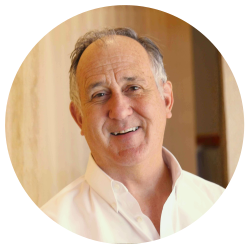
David McIntosh
Instructor, Harvard University; Executive Author, Facilitator, and Speaker
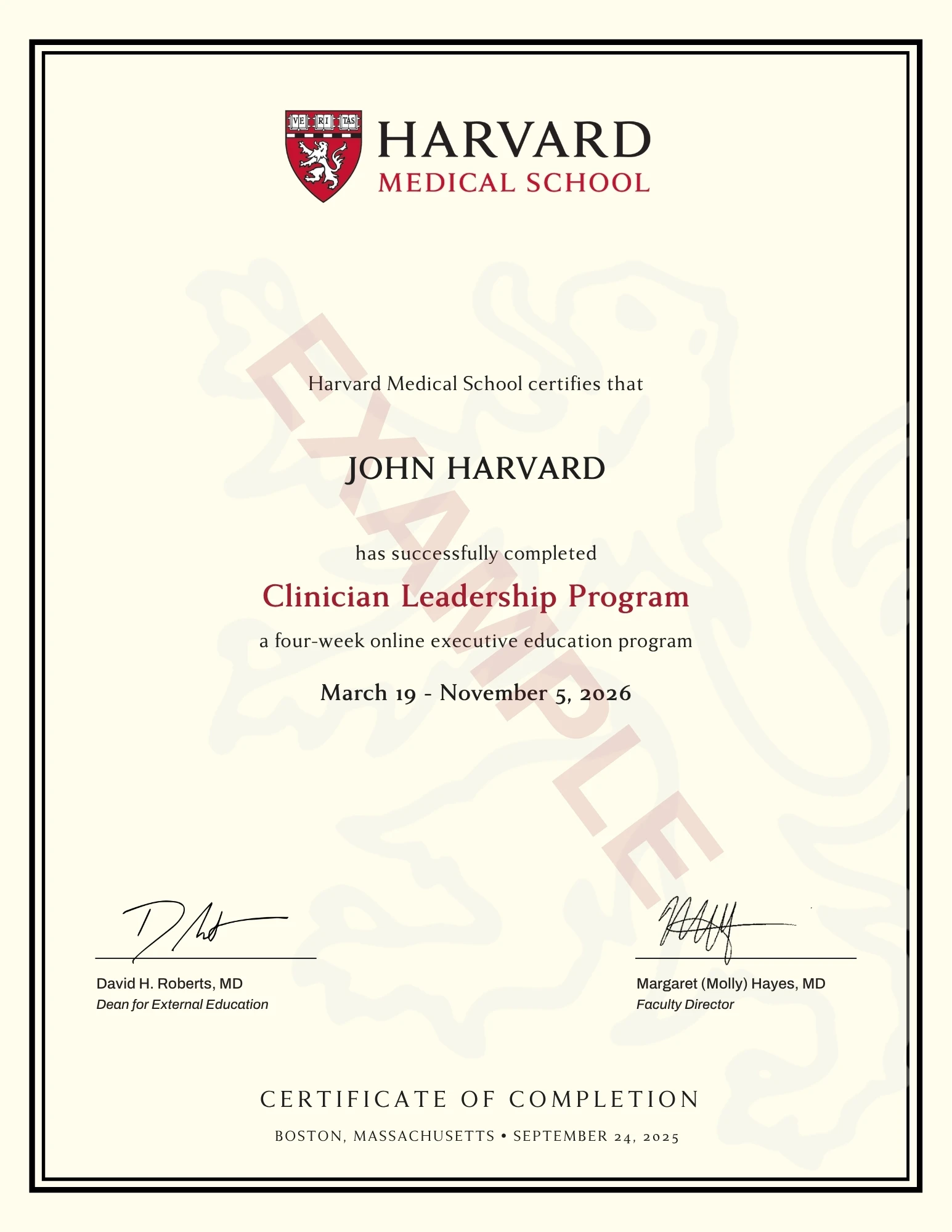
Certificate of Completion
Upon completing the program, you will receive a digital certificate of completion from Harvard Medical School.
Your digitally verified certificate will be issued in your legal name and emailed to you at no additional cost, as per the stipulated requirements. All certificate images are for illustrative purposes only and may be subject to change at the discretion of Harvard Medical School.
Note: The certificate details (name and dates) are placeholders. The final certificate will reflect the actual participant name, cohort dates, and date of issue.
Frequently Asked Questions
What is the weekly time commitment?
Participants spend approximately four to six hours per week on curriculum content and applied activities, with five live online sessions throughout the program.
Do I need prior leadership experience?
No. The curriculum is designed for clinicians at various stages of health care leadership and focuses on building foundational and advanced leadership capability.
Is the on-campus immersion required?
No. The two-day immersion is optional but provides a valuable networking and faculty interaction opportunity.
Will I receive a certificate?
Yes. Participants who complete all program requirements receive a digitally verified certificate from Harvard Medical School.
What technology do I need?
A reliable internet connection and a computer capable of accessing the learning platform and live online sessions.
Can international clinicians enroll?
Yes. The program welcomes global participants who meet the English-language and experience requirements.
Who will be collecting payment for the program?
Emeritus collects all program payments, provides learner enrollment and program support, and manages learning platform services.
What is the program refund and deferral policy?
For the program refund and deferral policy, please click the link here.
How can I become a certified health care leader?
There is no single certification required to become a health care leader. Leadership credibility is developed through formal education, practical experience, and demonstrated impact. Executive education programs like the Clinician Leadership Program support this growth and award a digital certificate of completion, complementing existing clinical credentials.
What makes the Clinician Leadership Program worth the investment?
The Clinician Leadership Program offers a high-impact return by combining Harvard Medical School’s academic rigor with practical leadership training designed for real health care challenges. Participants gain immediately applicable skills in communication, decision-making, team leadership, and system-level thinking — supported by expert faculty, live sessions, and a guided capstone.
How much does the Clinician Leadership Program cost?
Program fees are listed on the official program page. The cost includes teaching fees and access to online coursework. It does not include accommodations for the optional networking event, travel expenses (domestic, international, visa fee, and more), and other expenses not specifically mentioned in the fee. Flexible payment options are often available, making it easier for professionals to enroll in the program and advance their leadership skills.
What is the best executive health care leadership program?
There is no single best executive leadership program for everyone. The right program depends on your goals, experience, resources, and leadership context. The Clinician Leadership Program offers health care-focused content (including leadership in the age of AI), expert faculty, a global peer community, and an optional on-campus networking event. Its structured 17-week curriculum delivers both leadership depth and practical application in a time-efficient and cost-effective way, making it a convenient alternative to longer flagship programs that require in-person participation.
Is the Clinician Leadership Program suitable for physician leaders?
Yes. The Clinician Leadership Program is well suited for physician leaders. It is designed to empower physicians by strengthening leadership, communication, and strategic decision-making skills while addressing the realities of leading teams and influencing systems in complex health care environments. Physician leaders who are looking to develop finance and business acumen, or receive professional mentoring, may be ideal candidates for other physician leadership programs.
How does Emeritus support accessibility for learners?
Emeritus is committed to making high-quality education accessible and affordable to individuals, companies, and governments around the world. If you have questions about accessibility or would like to discuss available support options before enrolling, please contact accessibility@emeritus.org. For more information about our accessibility practices, please review our Accessibility Policy here.
Connect with a Program Advisor for a 1:1 Session
Email: learner.success@emeritus.org or schedule a call with one of our Program Advisors or call us at +1 567 485 3647 (US) / +44 1182 302681 (UK) / +65 3138 4864 (SG) / +971 80 0088601092 (UAE) / +52 55970 98868 (LATAM)
Flexible payment options are available.
Starts On